Vuelta a España 2019 – Route Preview
Post Series: Vuelta a España 2019
- 1.Vuelta a España 2019 – Route Preview
- 2.Vuelta a España 2019 – Team Preview
- 3.Vuelta a España 2019 – GC Favorites Preview
- 4.Vuelta a España 2019 – Stage 1 Preview
- 5.Vuelta a España 2019 – Stage 2 Preview
- 6.Vuelta a España 2019 – Stage 3 Preview
- 7.Vuelta a España 2019 – Stage 4 Preview
- 8.Vuelta a España 2019 – Stage 5 Preview
- 9.Vuelta a España 2019 – Stage 6 Preview
- 10.Vuelta a España 2019 – Stage 7 Preview
- 11.Vuelta a España 2019 – Stage 8 Preview
- 12.Vuelta a España 2019 – Stage 9 Preview
- 13.Vuelta a España 2019 – Stage 10 Preview
- 14.Vuelta a España 2019 – Stage 11 Preview
- 15.Vuelta a España 2019 – Stage 12 Preview
- 16.Vuelta a España 2019 – Stage 13 Preview
- 17.Vuelta a España 2019 – Stage 14 Preview
- 18.Vuelta a España 2019 – Stage 15 Preview
- 19.Vuelta a España 2019 – Stage 16 Preview
- 20.Vuelta a España 2019 – Stage 17 Preview
- 21.Vuelta a España 2019 – Stage 18 Preview
- 22.Vuelta a España 2019 – Stage 19 Preview
- 23.Vuelta a España 2019 – Stage 20 Preview
- 24.Vuelta a España 2019 – Stage 21 Preview

At this time of the year all eyes are once again pointed towards La Vuelta. One of the 3 Grand Tours that is often characterized by a lot of climbing on steep ramps, hilly terrain and a tough life for the sprinters that dare to participate. This week we will release a number of key articles on this years Vuelta a España, ranging from parcours previews to team previews and jersey contenders.
Today we will start with the first of these articles: Vuelta a España Route Preview, so let’s head over to the route!
TLDR:
We realize that even though we spent a lot of time writing an extensive per-stage preview, not everyone has time to go over the entire article. Therefore we provided some key points of this years route below.
Key Points
- 1x TTT (stage 1)
- 1x ITT (stage 10)
- 4x ‘true’ sprint stages (stage 4, stage 14, stage 17, stage 21)
- 4x ‘climbing sprinters/sprinting climbers’ stages (stage 2, stage 3, stage 8, stage 19)
- 6x classic breakaway stages (stage 6, stage 11, stage 12, stage 16, stage 18, stage 20)
- 5x days where a GC rider could battle for the win, featuring:
- 2 mur’s (stage 7, stage 13)
- 3 uphill mountain finishes (stage 5, stage 9, stage 15)
Likeliest scenario’s
Please note that the above is what we consider the most likely scenario. Race dynamics and personal interests of teams/riders could easily turn a GC stage into a breakaway stage or a breakaway stage into a sprint stage.
Break or GC/Sprint?
There is a large chance that stages like stage 15 and stage 20 will be won from the break if the Vuelta is ‘finished’ GC-wise at this point with so many teams bringing their climbing breakaway specialists. Given that a large fraction of the teams entirely built their squad around breakaway wins, and given that the relative differences in team strengths seem so large (Jumbo Visma, Movistar and Astana being miles ahead of the rest of the teams), we could very well see a huge amount of breakaway wins. Sports-betting-wise we would love this as it would offer us a lot of extraordinary value, but it will all depend on how the race plays out.
The organisers opinion
With our categorisation we somewhat deviate from the Spanish organisers, who appearantly consider stage 2, 3, 4, 8, 11, 12, 14, 17, 19, and 21 mass sprints. Spanish flat huh?
Relative importance of stages in regards of GC
We’ve also provided stars per stage, that indicate the importance of the stage in regards to the GC:
Stage 1 (TTT): **
Stage 2: *
Stage 3: *
Stage 4: *
Stage 5: ***
Stage 6: *
Stage 7: ****
Stage 8: *
Stage 9: *****
Stage 10 (ITT): ****
Stage 11: *
Stage 12: **
Stage 13: *****
Stage 14: *
Stage 15: ***
Stage 16: ***
Stage 17: *
Stage 18: ***
Stage 19: *
Stage 20: **
Stage 21: *
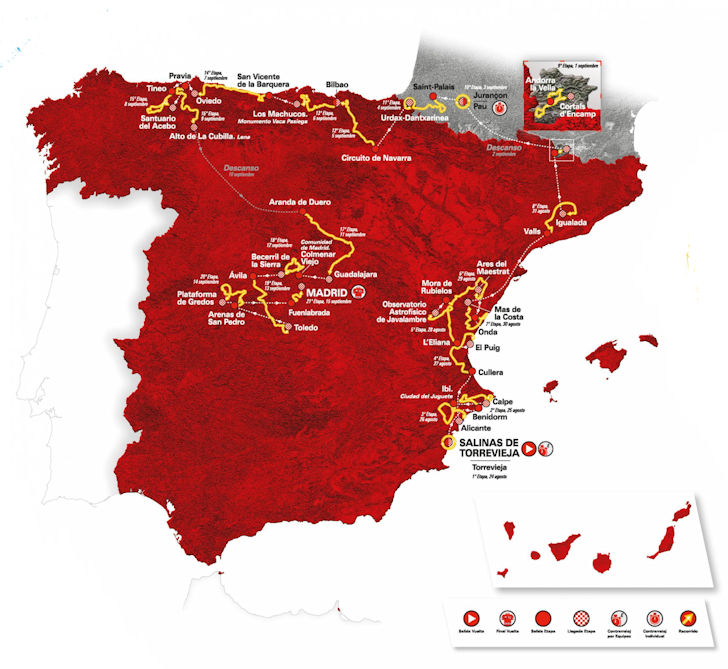
The route contains all the usual stuff that we can expect from the Vuelta: ‘flat’ stages that contain steep climbing, long mountain stages and some of the most insanely steep mur’s of Europe.
In our opinion, the nicest thing of this years route is that it contains elements of all the cycling subspecializations: steep mur finishes, long and tough grinding-like mountain stages that end both uphill as well as downhill, individual time trialling, team time trialling, and a mixture of both ‘easy’ sprint stages and stages that are seemingly flat, but contain enough obstacles in the finale to allow a different ‘type’ of sprinters to shine as well.
We think the organisers did a perfect job at spreading these type of stages over a 21-stages long route. As you can see at the star-indication that we gave each stage, the center of gravity of this Vuelta is -GC wise- right in the middle of the Vuelta. The first week is somewhat comparable to the Volta a Catalunya one-week stage-race, which also guarantees a lot of spectacle! Compared to other grand tours this years Vuelta’s 3rd week is relatively easy, which will force riders to put their cards on the table earlier along the route than usual. There are a lot less opportunities to make up minutes of time loss in the final stages!
What follows now is an extensive per-stage overview of the route, indicating key stage elements and a lot of other relevant information for every dedicated cycling follower!
Stage Overview
Stage 1:
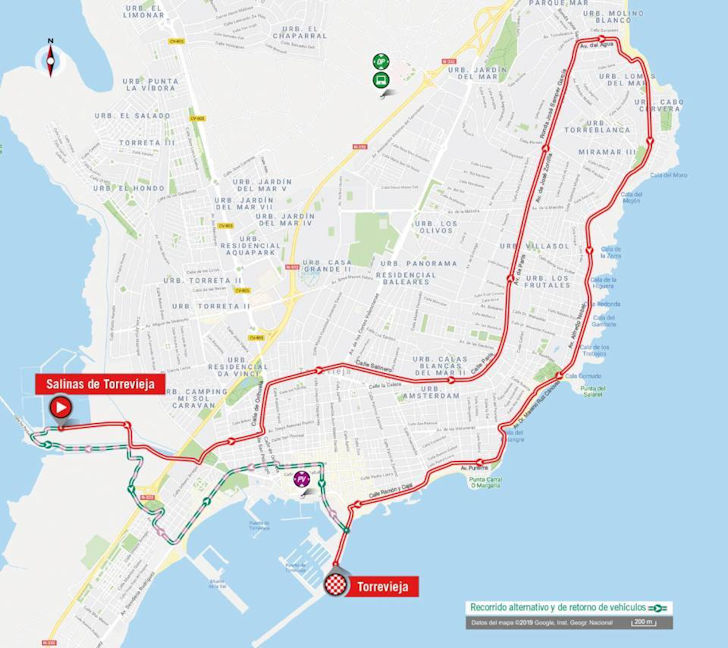
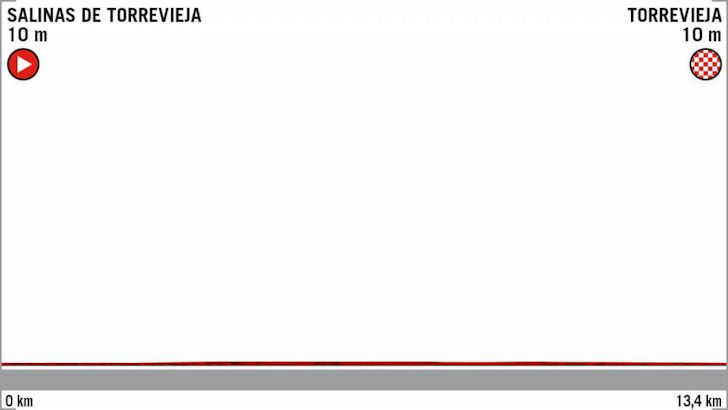
A 13.4 km panflat Team Time Trial near Torrevieja that is not too technical. With Jumbo Visma’s impressive 2019 TTT credentials and their strong line-up they will be the team to beat here in the fight for the first Red Jersey of this edition of the Vuelta.
We classify this stage as: TTT
Stage 2:
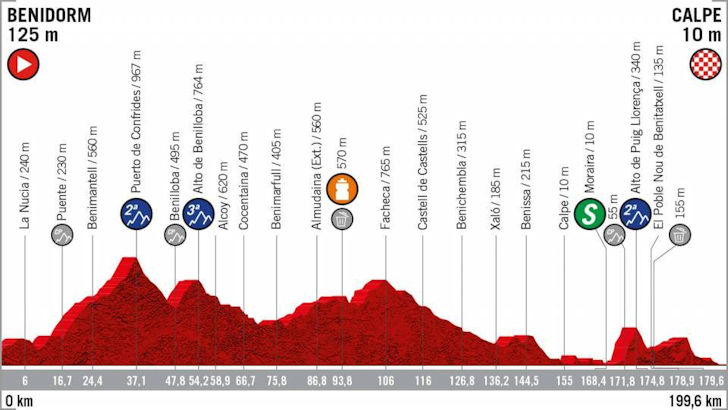
The second stage already contains quite a lot of climbing work, with two 2nd category cols of which one is located 25km ahead of this day’s finish line. This climb -the Alto de Puig Llorenca- is 3 km’s long with an average gradient of 9.5%. What follows afterwards is a few kilometers of false flat, some descending and 6 final flat kilometers. We expect that the final climb will be too tough for most of the pure sprinters, and we expect a mixture of climbing sprinters and punchy climbers to contest for the win.
We classify this stage as: climbing sprinters/punchy climbers
Stage 3:
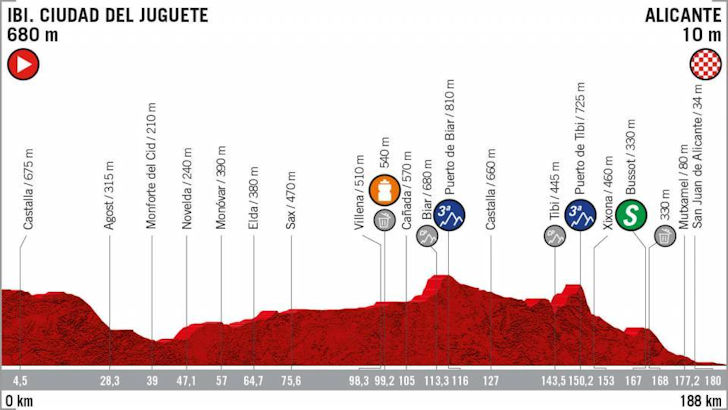
A comparable stage to stage 2. The final climb is a bit easier than the Alto de Puig Llorenca, although its still 5% for almost 7 km with some descending inbetween, meaning the actual ‘climbing’ gradient will average 7%. Also, the final 30km will be mostly downhill, perfect to defend an established gap all the way to the finish line to take a stage-win and to get a shot at the Maglia Rossa! A stage that could could either end up in a breakaway win, a mass sprint or a reduced sprint. It entirely depends on the pace in which the race is ridden.
Yet, we classify this stage as the in our opinion most likely scenario: climbing sprinters/punchy climbers.
Stage 4:
This one should be for the sprinters. A stage that is ‘panflat’ by Spanish standards. Some sprinters might lose some terrain on the Puerto de Tibi, but there will be plenty of time to ensure a safe sprint for the sprinters. Even the ‘heavier’ sprinters like Walscheid and Jakobsen will sense an opportunity for a stage-win here.
We classify this stage as: sprint
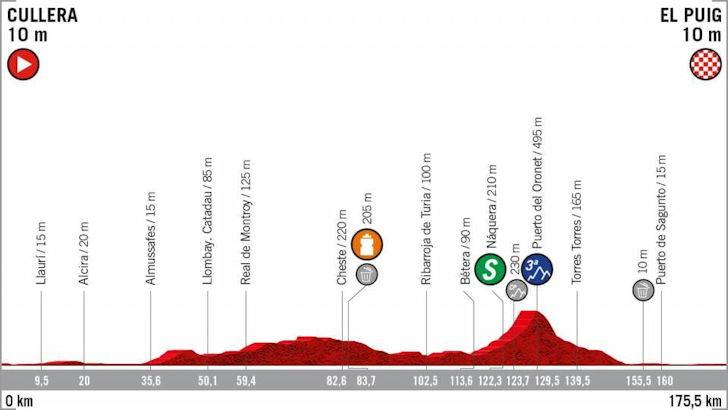
Key Stage! Stage 5:
Awesome stage! One of the key stages in this Vuelta. The typical ____/ stage profile that will ensure a furious pace on the final climb.
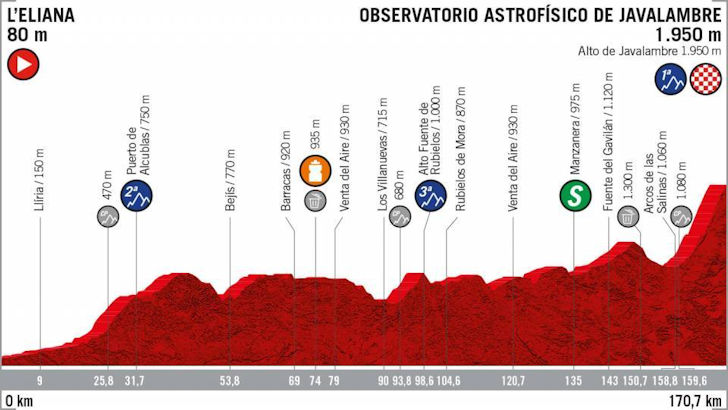
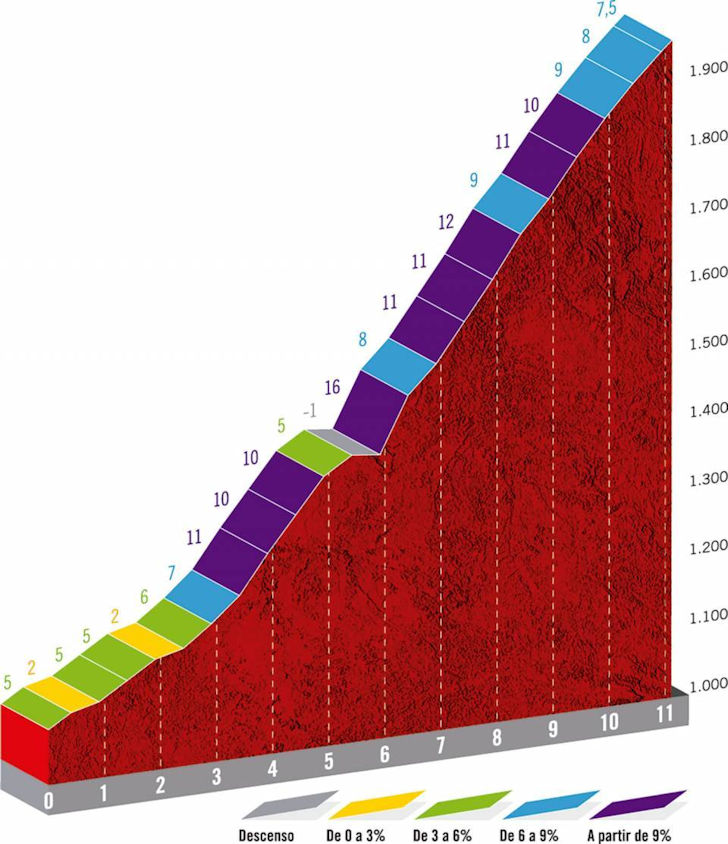
The first categorized Alto de Javalambre could be considered false-flat, but the final 8 kilometers are almost entirely double digit. This stage screams Dylan Teuns to me, but as always there are plenty of other strong climbers that will be looking forward to fight for the stage-win (and a Maglia Rossa that might be up for grabs today).
We classify this day as: GC
Stage 6:
After the intense final climb of stage 5 it will be very likely that a breakaway will be allowed to battle for victory on this hilly stage. Rolling terrain for the first 160km will allow plenty of opportunities for a breakaway to make their move. The initial 160km are followed upon by two consecutive -not too difficult- climbs. The final climb, the Puerto de Ares, is a 7.9 km long climb with an average and by spanish standards steady gradient of around 5% – not overly difficult. You can expect that the standard breakaway artists like Thomas de Gendt will have marked this stage in red.
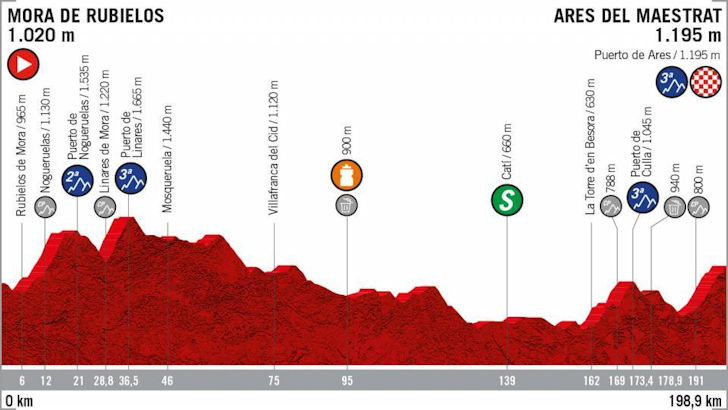
We classify this stage as: breakaway
Key Stage! Stage 7:
A proper mur, yay! This stage is bound to yield a super interesting finale where the strongest of the GC men will fight to put time into their rivals!
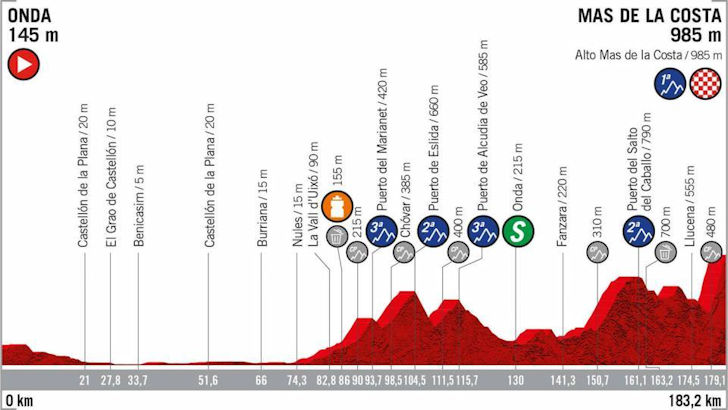
The climbing work that preceeds the final climb will tire the legs, after which it will be each for himself in a 4 km long uphill sprint.
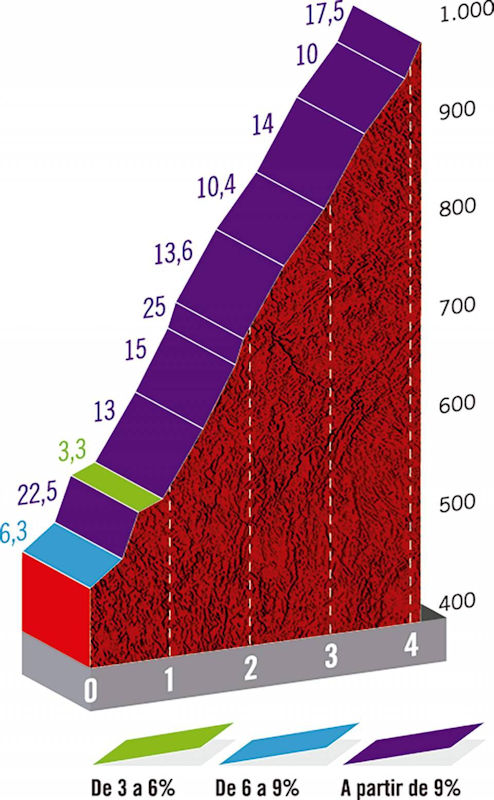
Expect absolute carnage with some riders almost standing still and other riders putting a suprising amount of time into their rivals in such a short distance! With sections of 25 (!)% and an average gradient of 12.3% for over four kilometers. These ultra-steep gradients will favor the lightweight pocket-climbers like Chaves, as well as the punchy riders that we know for races like Fleche-Wallone like Valverde. This could be a day for the breakaway, but given the depth of some of the teams whose GC riders are suited towards these type of climbs, we think and hope that they will keep the breakaway on a leash and battle it out in the final 4km.
We classify this stage as: GC
Stage 8
A stage like stage two, where we expect a mixture of climbing sprinters and punchy climbers to contest for the win. Categorised as ‘flat’ by the organisers, but we know the Spanish definition of flat. The main climb of the day, the Monistrol de Montserrat is 8.2km @ 6.9% ends with 30km to go, including 10 km of flat at the end. Whether a break will make it to the finish line or not will depend on the willingness of the teams with durable sprinters to chase down the early break. Given that some of the ‘second tier’ sprinters will see this as a chance to take a GT stage-win, as it is expected that the pure sprinters will not be there in the finale, we expect a fair chance that the break will be reeled in on time or that we will see some of these riders in the morning break.
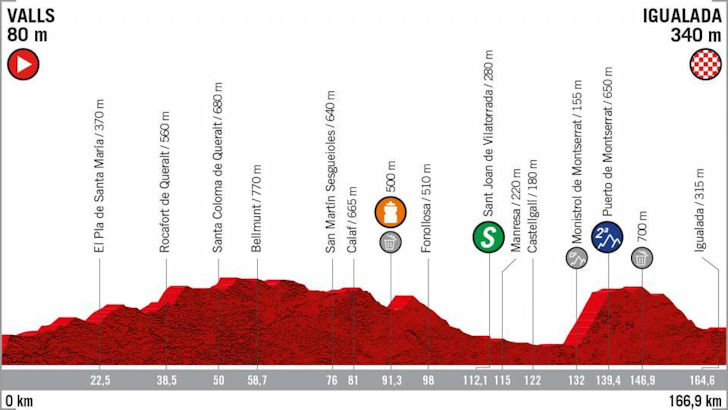
We classify this stage as: climbing sprinters/punchy climbers
Key Stage! Stage 9:
Another important GC day. The first ‘real’ mountain stage and a rather impressive one! The organisers have opted for the popular short ‘racing from the gun’ stage format and have created a 94 kilometers long stage with some very challenging climbs!
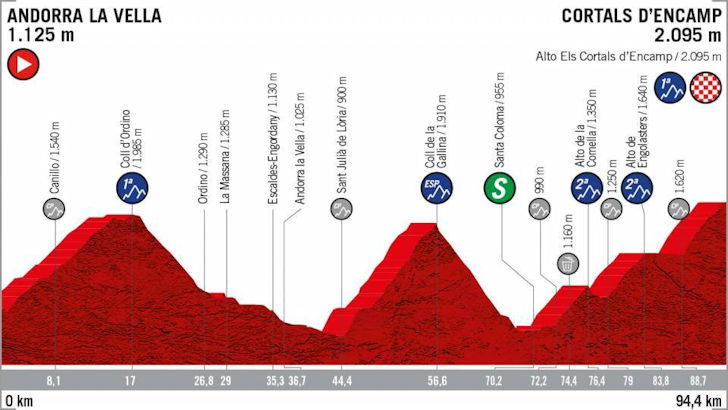
The race commences with the Coll d’Ordino, which is probably the easiest of the obstacles with 8.9km @ 5%.
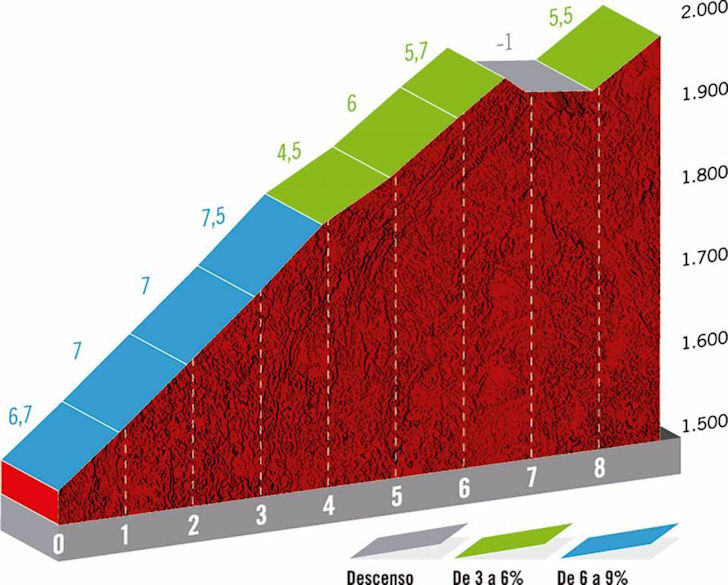
After a descent, the Coll de Gallina (12.2 kilometers at 8.3%) shows up. A hors categorie climb where only the strongest of climbers will be able to keep up. This climb will be loved by the purest of climbers like Miguel Angel Lopez, because of the constant gradient shifts which prevents climbers who like to ride climbs at a steady high pace -like Kruijswijk and Roglic- to settle into a comfortable tempo. Unfortunately, the climb might be too far from the finish line to truely crack some of the strongest of the GC contenders, but we hope for some typical Movistar/Astana far-out attacks as it would make the stage even more interesting!
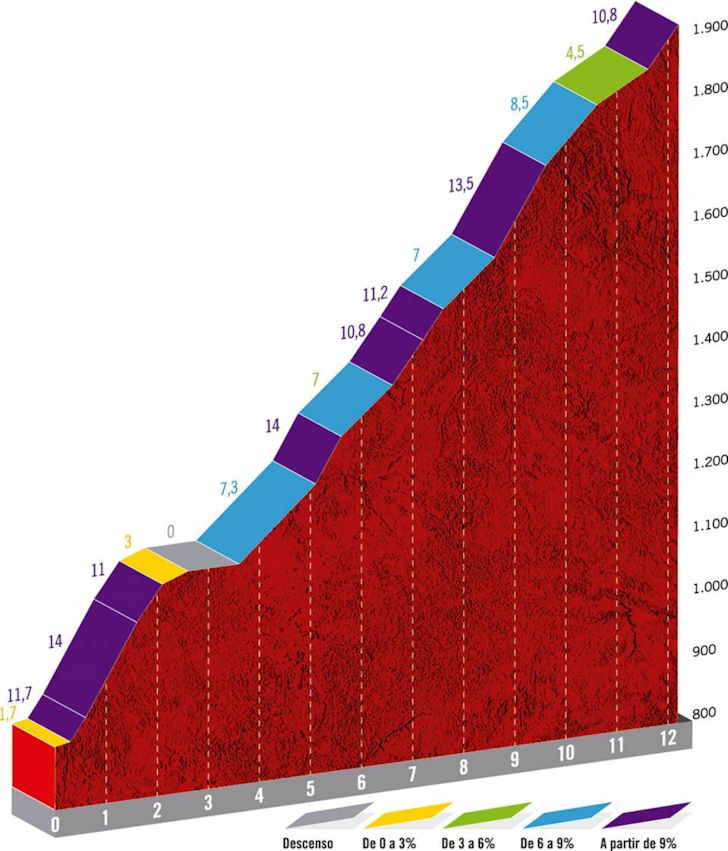
We expect that the GC battle will ignite during the ascent of one of the final 3 climbs which are basically tackled consecutively. First up is the Alto de la Commala (4.2 km @ 8.6%). What follows is a short descent which leads us to the sub-final climb of this stage the Alto de Engolasters (4.8km @ 8.1).
From the top of the Engolasters to the base of the final climb we have ourselves a gravel section of four kilometers! Which means no time for recovery and a lot of stress amongst GC riders! With a high likelihood that most of the GC riders will be isolated at this point of the stage, a mechanical at this point of the race will be disastrous!
The one who is first to arrive on top of the final climb (the Cortals d’Encamp – 5.7 km @ 8.3%) will be able to call himself a GT stage winner!
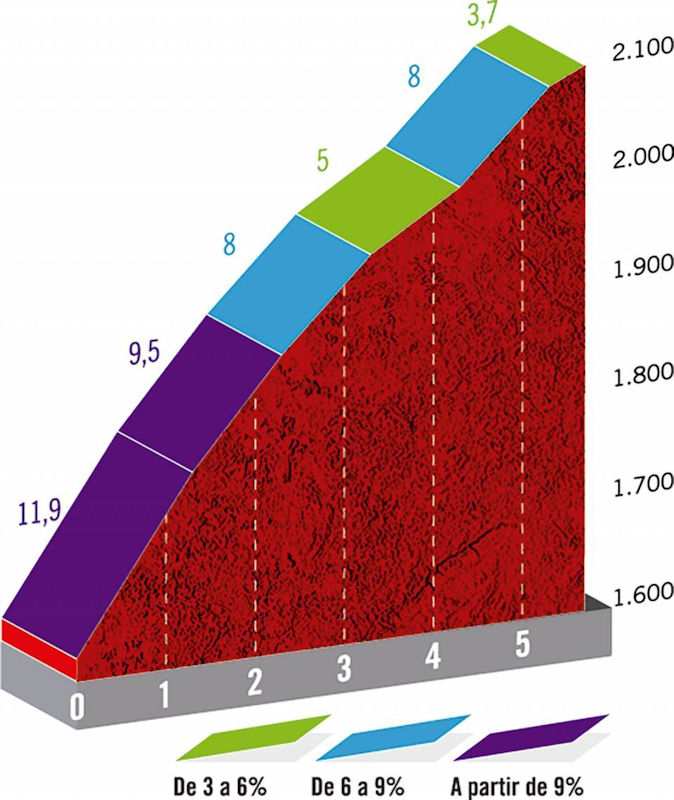
As you can see on the profile the venom of the final climb is in its first kilometers. Riders who are feeling strong after 90 kilometers of ascending and descending will have to launch their attacks at the very beginning of this climb if they want to gain significant time on their rivals. It is very cliche to say, but a lot of riders will lose their Vuelta GC ambitions on this day.
We classify this stage as: GC
The tenth day of the Vuelta will be a rest day, after which we commence the second week of La Vuelta, which starts with a time trial!
Key Stage! Stage 10 (ITT)
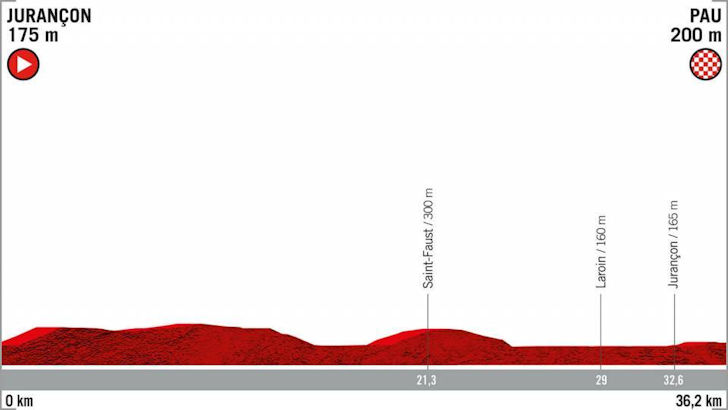
After the well-deserved rest day the peloton will continue its way to Madrid in a 36.2km long time trial that contains plenty of difficult corners and will take us from Jurancon to Pau.
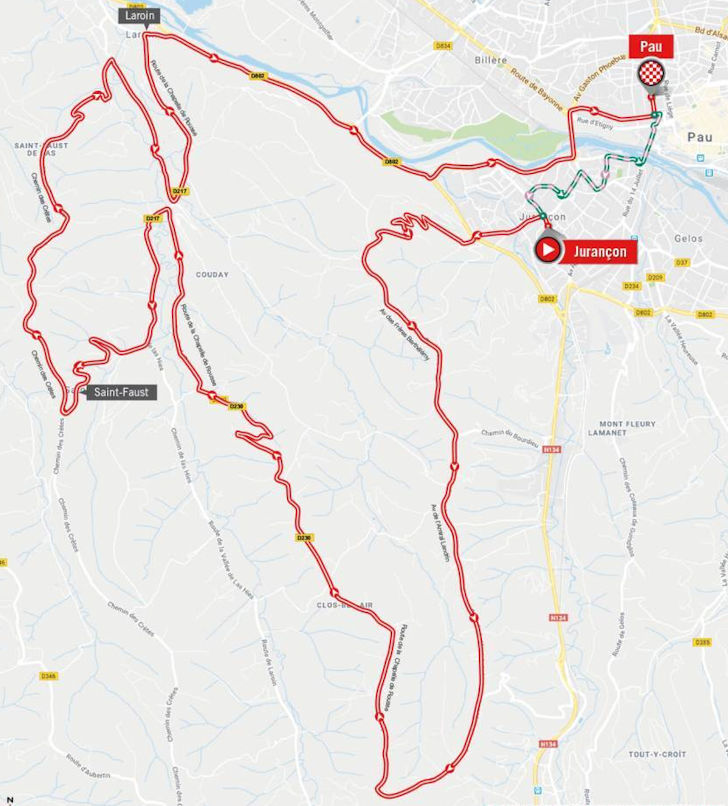
The profile has somewhat of a rolling terrain, but will be considered flat by most of the GC riders. Primoz Roglic will be looking to put time into his rivals today, but there are plenty of other strong ITT’ers who will try to challenge for victory, or to minimize their time loss compared to Roglic.
We classify this stage as: ITT
Stage 11:
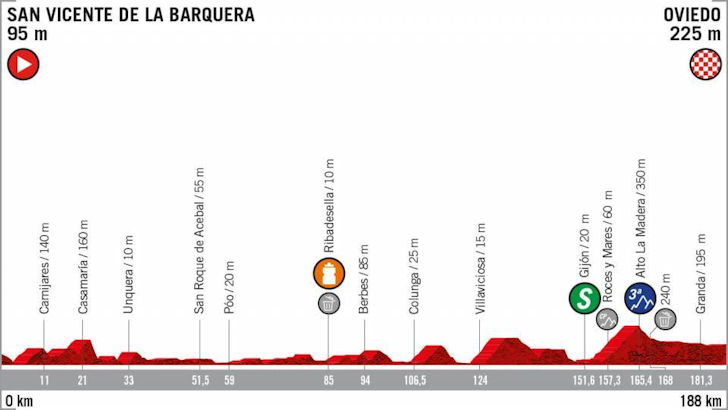
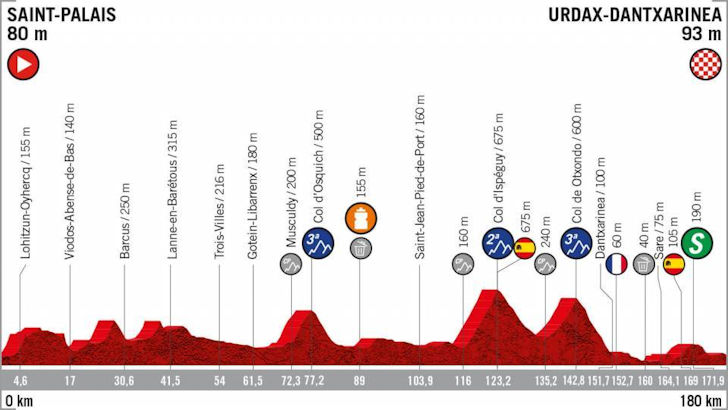
Stage 11 takes us from the Saint-Palais to Urdax-Dantxarinea and has the typical profile for a breakaway stage. The two climbs between 110 and 150 km will be too difficult for the sprinters given that it is only 20 more kilometers of rolling terrain to the finish line from there. The hilly first 40km of the stage will allow a strong breakway to establish and potentially make it to the finish line!
We classify this stage as: breakaway
Stage 12:
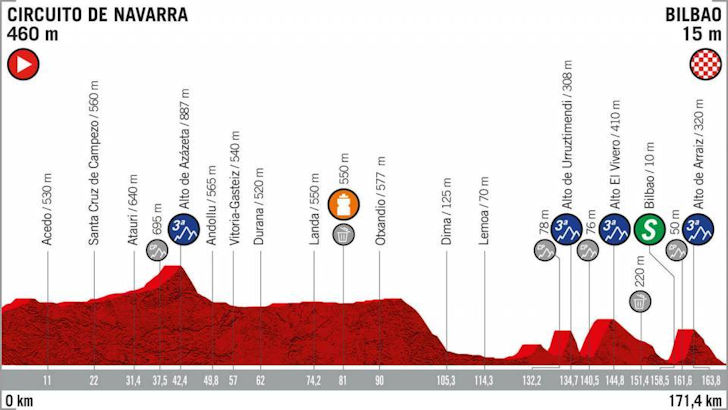
We’re very sorry for the sprinters, but another ‘flat’ stage which will not end in a group sprint. A very interesting stage where plenty of scenario’s could take place. A breakaway might make it all the way to the finish line and battle it out on the final climb (the Alto de Arraiz – which is 2.2km @ 12.2%), or some of the Fleche Wallone-ish GC riders might put their team to work to launch an attack on the steep final climb, as the finale of the stage is only downhill. This stage screams Roglic to us although we might get two for the price of one with a breakaway fighting for stage victory, and Roglic trying to put his punching and descending skills to work in the main group!
We classify this stage as: breakaway
Key Stage: Stage 13:
It is mur time again! Leave from your work early today because the finale is bound to cause fireworks!
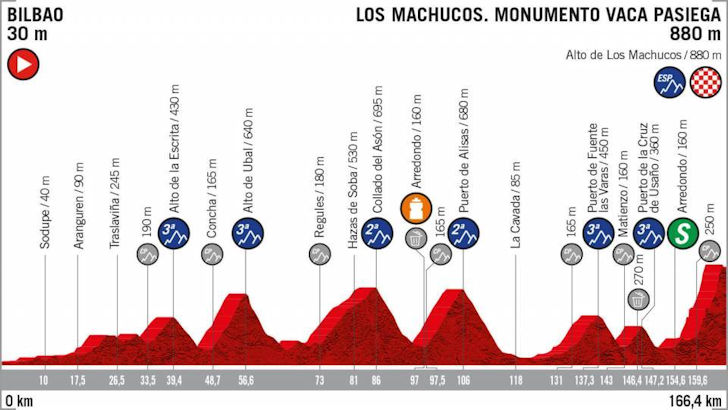
An entire day of relatively easy climbing and descending, which ends on the notorious Alto de Los Machucos. It was tackled before in 2017 and the figure below shows just how large the time differences can get on such a short (6.8 km) climb.
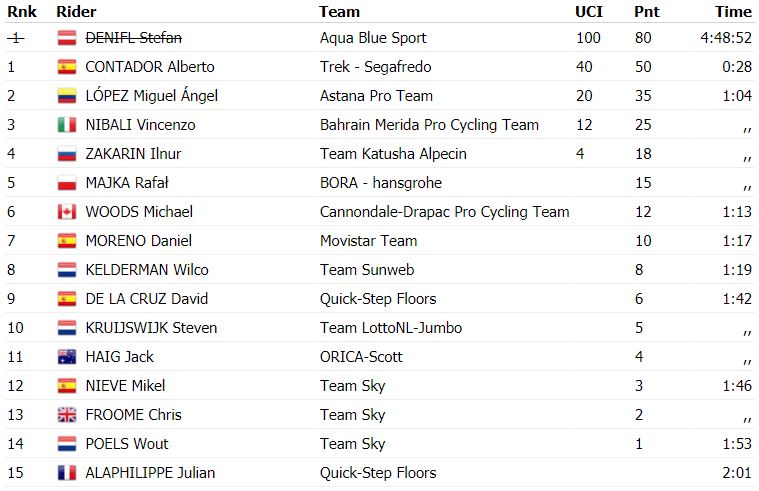
It is given in the road-book as 6.8 km @ 9.2%, but it is called the ‘rampas inhumanas’ for a reason. It is super irregular and features lots of inhumane ramps up to a gradient of 25%! Food for the purest of climbers and we expect the 2017 top-15 to be a good indication for the type of riders that can challenge for the stage-win today.
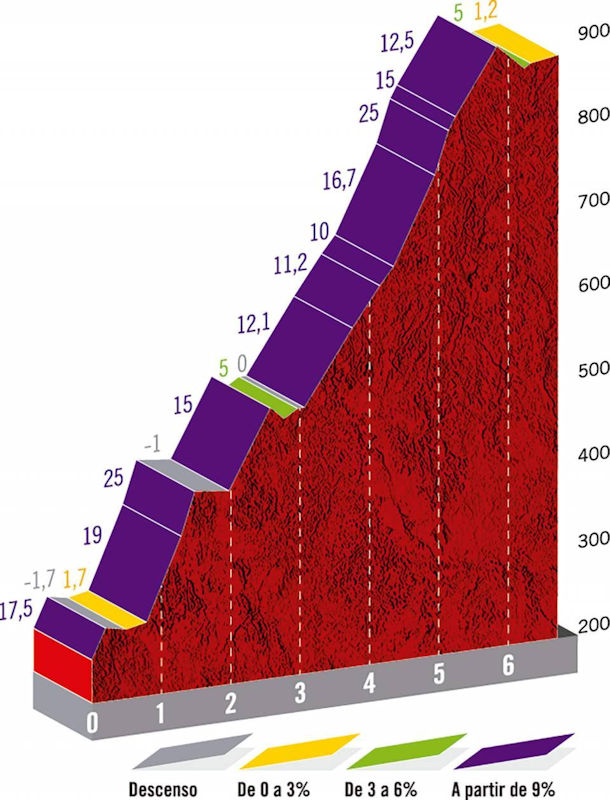
We classify this stage as: GC
Stage 14:
Finally, a sprint! The steady false flat climb (8 km @ 3.5%) won’t drop even the purest of sprinters. A nice day for a royal sprint!
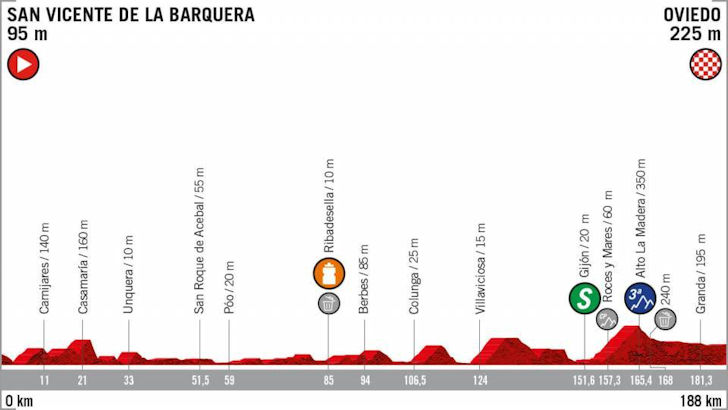
We classify this stage as: sprint
Key Stage! Stage 15:
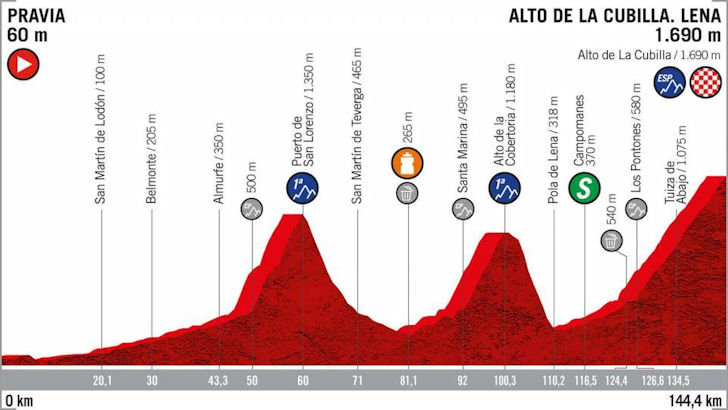
Stage 15 is only 140 kilometers long and features four 1st category climbs, ending with the ascent of the Puerto del Acebo.
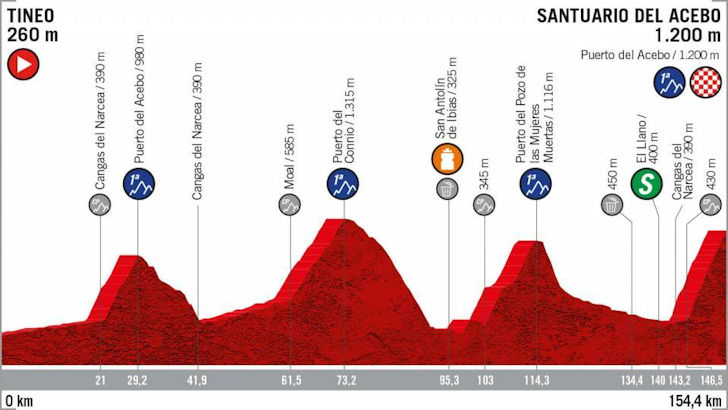
The first climb is also on the Puerto del Acebo but the riders take a different path. Because it is 30 kilometers from the (not overly difficult) penultimate climb to the final climb, we expect only to see true action on the very last climb: the ‘difficult’ ascent of the Puerto del Acebo:
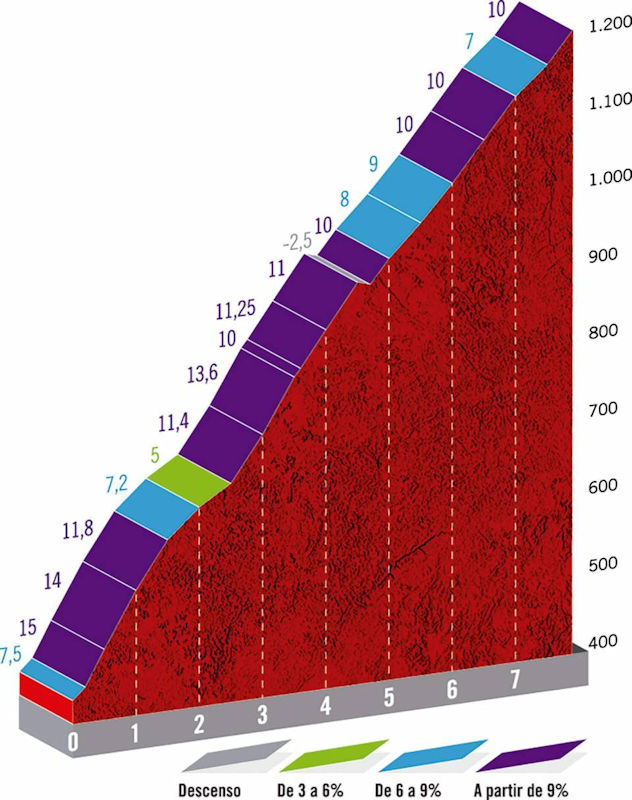
The climb is quite steady compared to some of the mountain finishes in earlier stages, which will be to the likings of riders like Steven Kruijswijk. Even though it is reasonably steady, it it really steep, with an average gradient of 9.7% for 7.9 kilometers.
We classify this stage as: GC
Key stage! Stage 16:
The final stage before the second rest day, with a final climb that suits the wattage grinders.
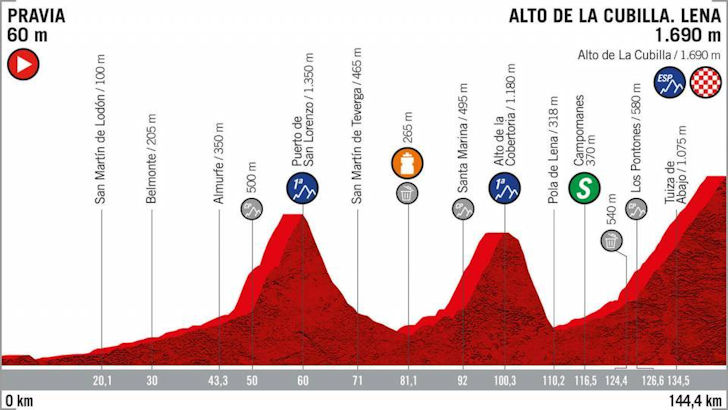
Attacks could be made on the steeper ramps of the penultimate climb (the Alto de la Cobertoria), as it is only descending and ascending from there-on.
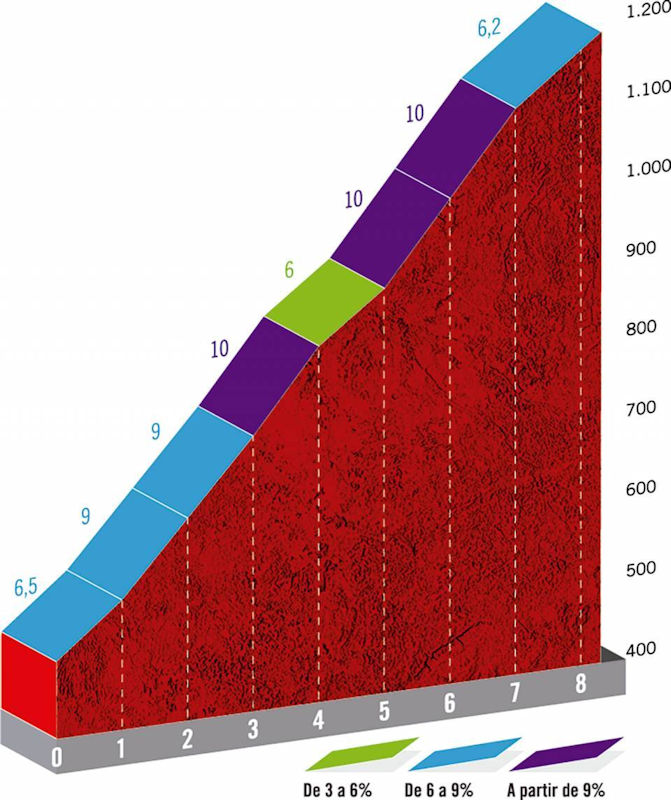
The final climb of the day is a long, steady climb (17.2 km @ 6.2%).
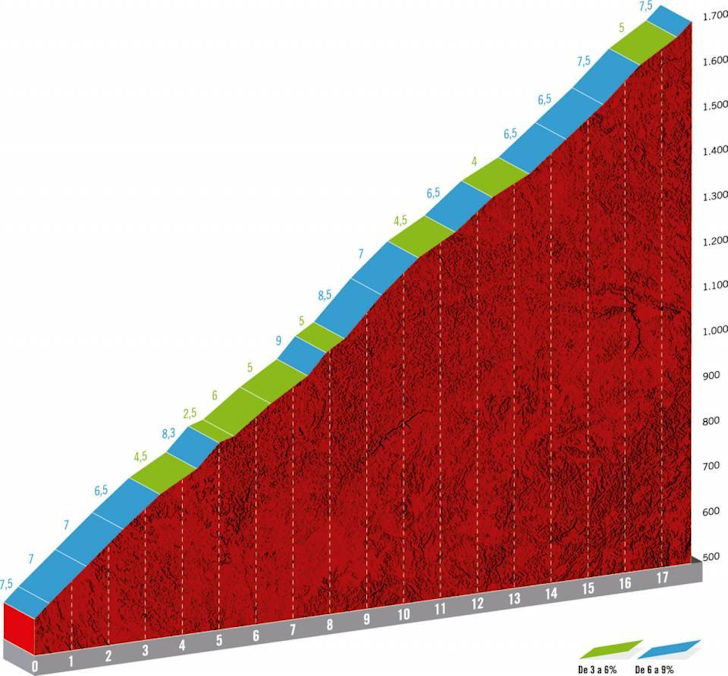
Given the 3rd cat climbs in the beginning of the stage, and the fact that some GC riders as well as lots of climbers will be miles back on the top of the GC by now, there’s a large chance we will see a strong break battling it out for the stage win here! GC wise, the final climb looks do-able for riders who are still contesting the GC at this point, but it is a rather long climb and we could see some tired legs as a result of two consecutive days of climbing from the go. Also, for the mountain jersey contestors, the top is this climb will grant extra points as it is designated as the Cima Alberto Fernandez this year. Another motivating asset for breakaway riders!
We classify this stage as: breakaway
After these climbing efforts the riders are allowed another precious and well-deserved rest day, before we continue our path to Madrid with a nice opportunity for the fast men in the peloton!
Stage 17:
Hurray, another sprint stage!
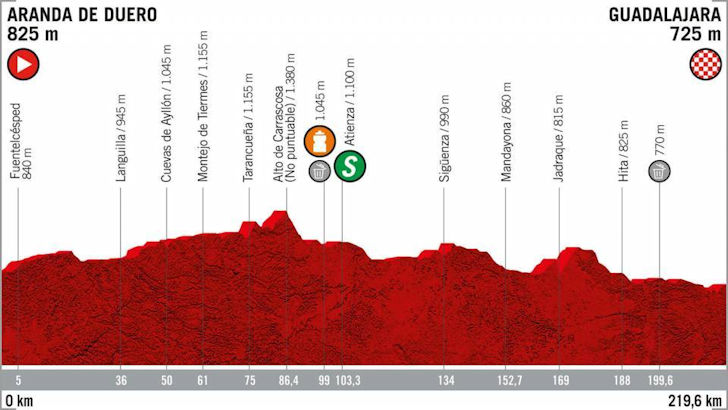
Should normally be one for the sprinters, the final of the stage goes somewhat uphill, which will mean that sprinters who do well on this type of finish will have marked this stage in the road book (Mezgec time!)
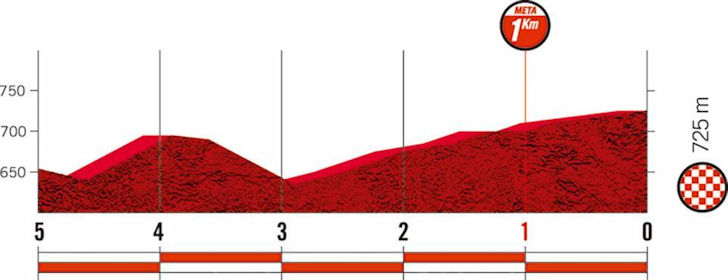
We classify this stage as: sprint
Stage 18:
Another mountain stage, but the climbs are less steep and we just can’t see riders that are still in contention for GC at this point lose a lot of time on the final climb. Still with four 1st category climbs this is a tough day in the saddle.
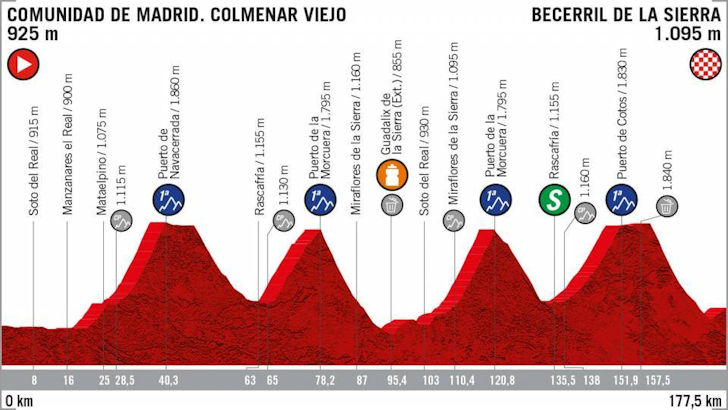
The finish is downhill, which could make stuff interesting, but we don’t think this stage will make or break the race.
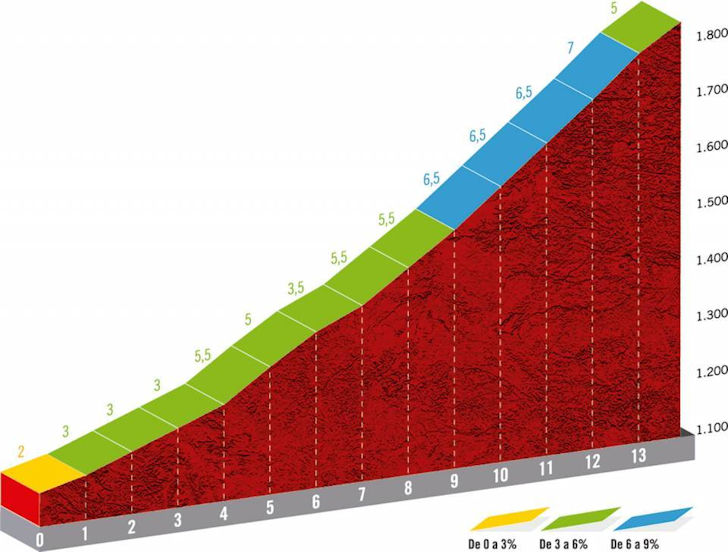
Whether a break will make it or not will all depend on the race dynamics at this point, but since we are categorising every stage, we categorise this stage as: breakaway
Stage 19:
A flat stage with a punchy finish. This will be one for the climbing sprinters or the sprinting climbers.
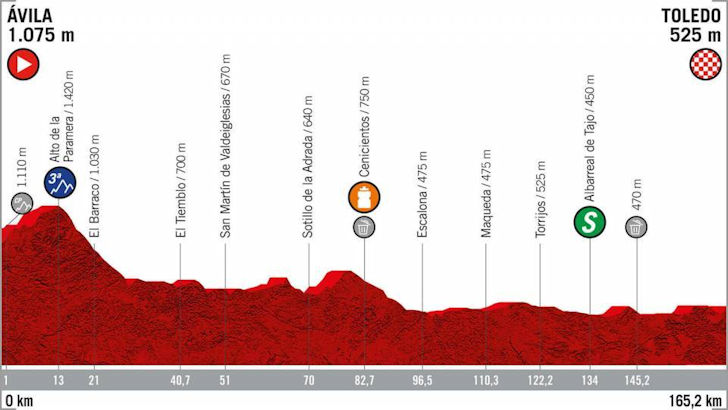
We don’t think the break has a chance on this type of parcours.
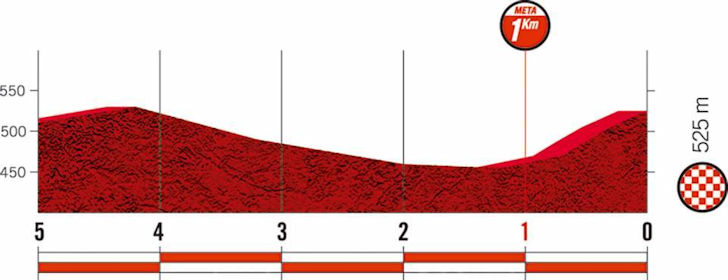
We classify this stage as: climbing sprinters/punchy climbers
Stage 20:
A lot of climbing that ends on a steep but short uncategorised up-hill finish.
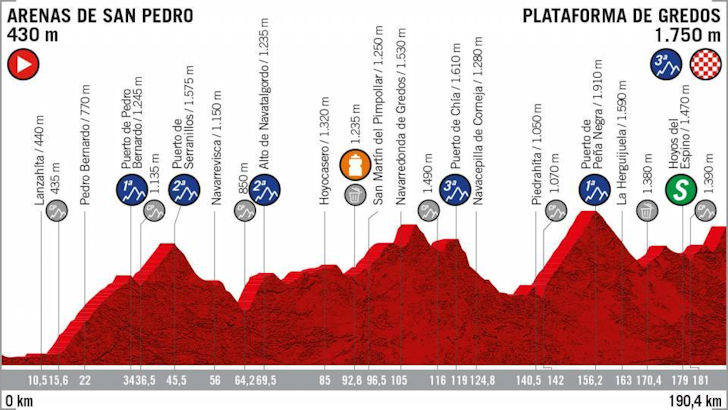
As you can see in the profile below, the final 3.5km go sharply uphill at around 8%. This should be a point where podium/overall contenders could launch their final all or nothing attack if time-differences are still manageable. Given the history of the Vuelta, differences will probably be too large at this point of the race for this to happen. Given that it is the last climbing stage however, someone will probably still have something to prove.
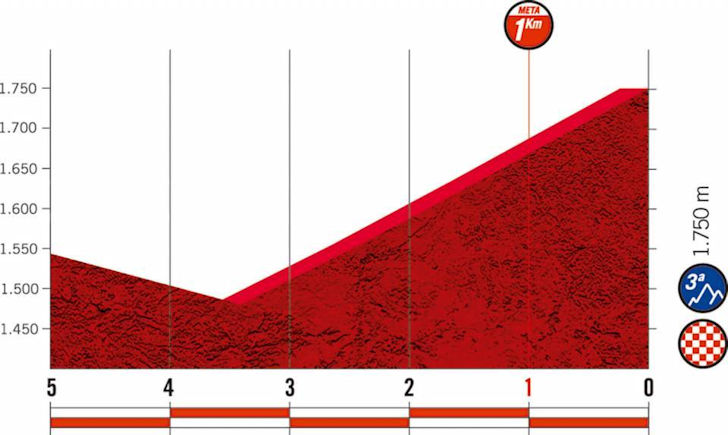
Given that there are always some sneaky riders who have saved themselves for three weeks to unleash all these saved wattage’s in a one-stage all-out effort.
We classify this stage as: breakaway
Stage 21:
Standard royal sprint stage. The riders that are still alive will battle for the win in the streets of Madrid!
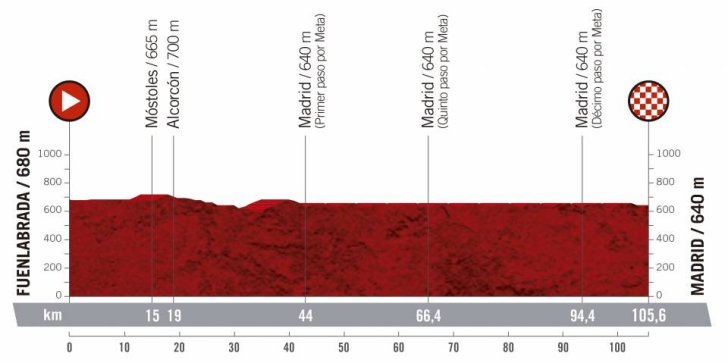
We classify this stage as: sprint
Fantasy-team tips
So given this parcours, which type of riders are bound to do well here? We will be providing some specific names in future articles later this week, but based on the parcours we will be loading up our team with 1) climbing sprinters, 2) strong breakaway climbers and 3) GC men who can handle the ultra-steep gradients along the route and who have a solid balanced squad to fall back on. The heaviest of sprinters will not get a place in our team as we simply don’t see enough opportunities for them.
The end:
If you are still reading at this point we are sure that your head will be spinning around from all the information that was launched upon you.
We’d like to thank you for reading our route preview and we hope it gave you some meaningful insights ahead of this exciting looking Vuelta!
As a final note we’d like to mention that we will be releasing team previews and jersey favorites later this week. We will also be doing daily stage previews troughout the entire #LaVuelta19!
If you would like to keep up with all our previews and betting advice, you can follow us on twitter: BehindThePeloton !
For now: Gracias por leer y hasta pronto!